
 Dartmon
 ROS1 Antibody (DA207)
IHC (FFPE)
Description
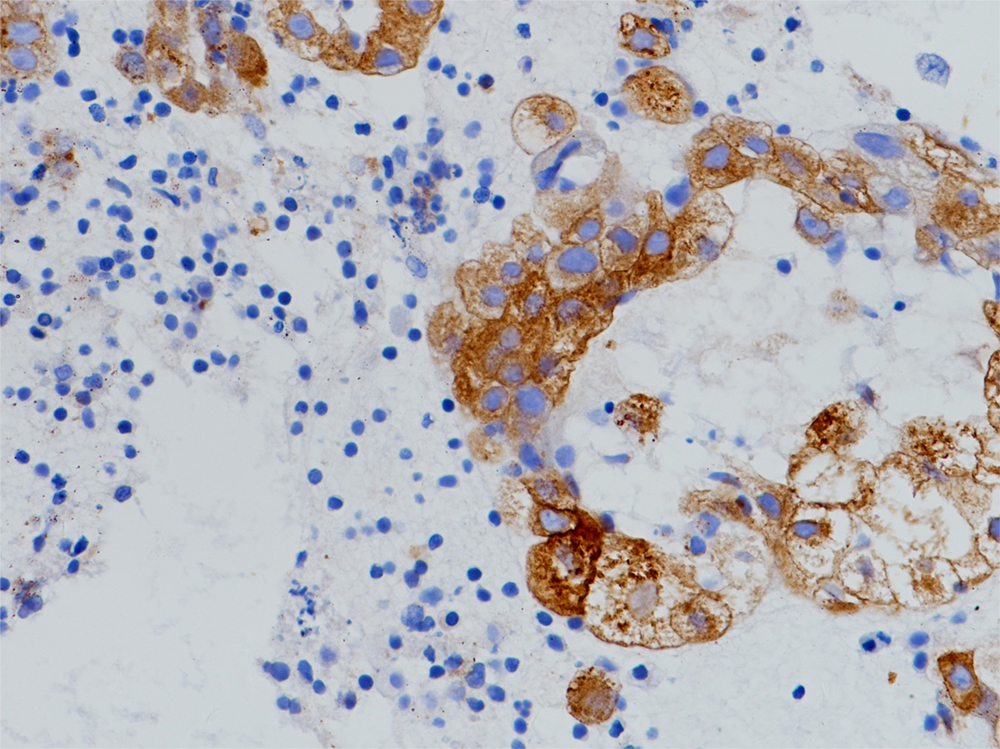
ROS1 (ROS Proto-Oncogene 1, Receptor Tyrosine Kinase) is a receptor tyrosine kinase that undergoes genetic rearrangements in various human cancers and in humans is encoded by the ROS1 gene. The protein encoded by this gene is a type I integral membrane protein with tyrosine kinase activity with structural similarity to the anaplastic lymphoma kinase protein. The protein may function as a growth or differentiation factor receptor. ROS1 expression is limited in normal tissues to occasional staining cerebellum, stomach, small intestine, colon and kidney.Gene rearrangements involving the ROS1 gene were first detect in glioblastoma tumors and cell lines. ROS1 fusion partners include CD74, SLC34A2 and SDC4, leading to oncogenic transformation. ROS1 rearrangement was identified in a cell line derived from a luadenocarcinoma patient and multiple studies have demonstrated its incidence in lung cancers. While ROS1 is undetectable in the normal lung, studies have described ROS1 rearrangements in 1-2% of NSCLC by FISH. Recent reports have demonstrated strong correlation between ROS1 IHC with FISH positivity. ROS1 fusions have been detected in multiple other tumors, including glioblastoma, non-small cell lung cancer, cholangiocarcinoma, ovarian cancer, gastric adenocarcinoma, colorectal cancer, inflammatory myofibroblastic tumor, angiosarc and epithelioid hemangioendothelioma.1-8 — Références — 1. "Entrez Gene: ROS1 v-ros UR2 sarcoma virus oncogene homolog 1 (avian)". 2. Rabin M, Birnbaum D, Young D, Birchmeier C, Wigler M, Ruddle FH . "Human ros1 and mas1 oncogenes located in regions of chromosome 6 associated with tumor-specific rearrangements". Oncoge Research.1987; 1 (2): 169–78. 3. Birchmeier C, Sharma S, Wigler M."Expression and rearrangement of the ROS1 gene in human glioblastoma cells". Proceedings of the National Academy of Sciences of the United States of America. 1987; 84 (24): 9270–4. 4. Rikova K, et al. "Global survey of phosphotyrosine signaling identifi oncogenic kinases in lung cancer". Cell. 2007; 131 (6): 1190–203. 5. Davies KD, Doebele RC. "Molecular pathways: ROS1 fusion proteins in cancer". Clinical Cancer Research. 2013; 19 (15): 4040–5. 6. Sholl LM, et al. ROS1 immunohistochemistry for detection of ROS1-rearranged lung adenocarcinomas. Am J Surg Pathol. 2013 Sep;37(9):1441-9. 7. Luk P, et al. Biomarkers for ALK and ROS1 in Lung Cancer Immunohistochemistry and Fluorescent In Situ Hybridization. Arch Pathol Lab Med. 2018;142:922–928. 8. U.S. Department of Health and Human Services: Centers for Disease Control and Prevention. Guidelines for Safe Work Practices in Human and Animal Medical Diagnostic Laboratories. Supplement / Vol. 61, January 6, 2012. https://www.cdc.gov/mmwr/pdf/other/su6101.pdf
Caractéristiques
- Type
- Recombinant monoclonal mouse antibody
- Clone
- DA207
- Isotype
- Mouse
- Réactivité
- Synthetic peptide of human ROS1
- Localisation
- Cytoplasm
- Usage prévu
- IHC (FFPE)
Conditionnements disponibles
1 référence(s) catalogue.
| N° catalogue | Type | Dilution | Volume | |
|---|---|---|---|---|
| DMRD0255 | Ready to use | 3ml, 6ml, 10ml | Demander un devis → |
Intéressé par ce produit ?
Indiquez la référence et le conditionnement souhaités, nous revenons vers vous rapidement.