
 Dartmon
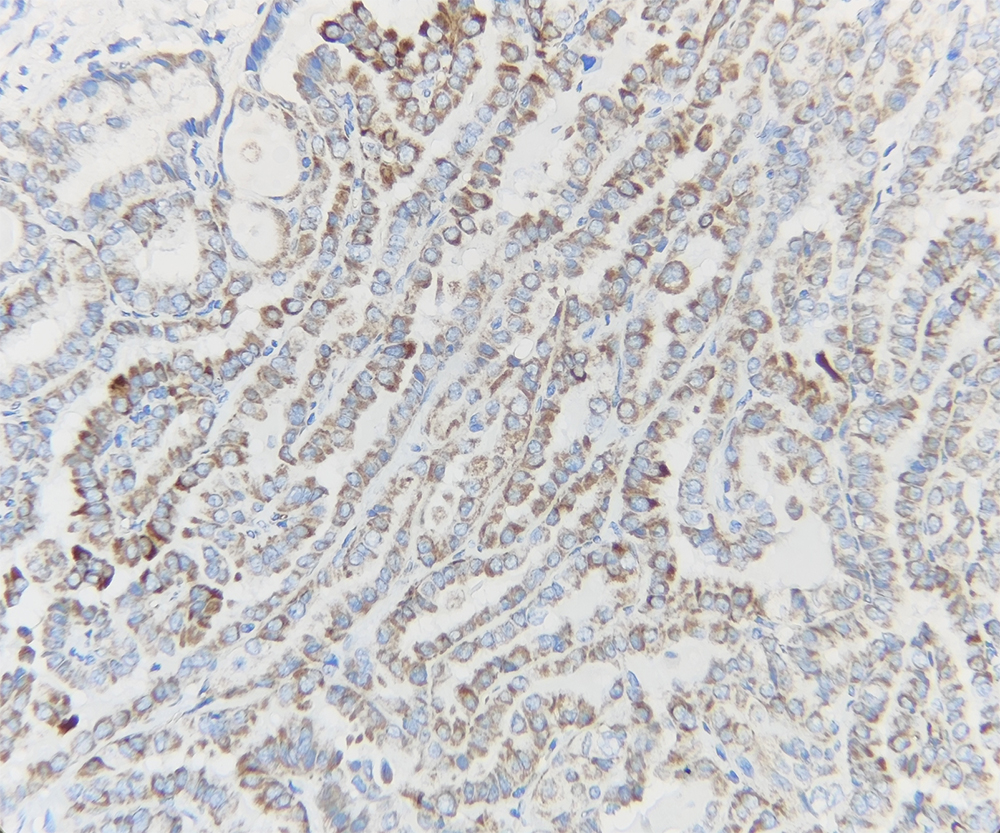
 BRAF Antibody (DA007)
IHC (FFPE)
Description
BRAF is a human gene that makes a protein called B-Raf, which is more formally known as serine/threonine-protein kinase B-Raf. The B-Raf protein is involved in sending signals inside cells, which are involved in directing cell growth. In 2002, it was shown to be mutated in some human cancers. Mutations in the BRAF gene can cause disease in two ways. First, mutations can be inherited and cause birth defects. Second, mutations can appear later in life and cause cancer, as an oncogene.Mutations in this gene have been found in cancers, including non-Hodgkin lymphoma, colorectal cancer, malignant melanoma, papillary thyroid carcinoma, non-small-cell lung carcinoma, and adenocarcinoma of the lung. The frequency of BRAF mutations varies widely in human cancers, from more than 80% in melanomas and nevi, to as little as 0–18% in other tumors, such as 1–3% in lung cancers and 5% in colorectal cancer. In 90% of the cases, thymine is substituted with adenine at nucleotide 1799. This leads to valine (V) being substituted for by glutamate (E) at codon 600 (referred to as V600E) in the activation segment that has been found in human cancers. This mutation has been widely observed in papillary thyroid carcinoma, colorectal cancer, melanoma and non-small-cell lung cancer. BRAF-V600E mutation are present in 57% of Langerhans cell histiocytosis patients. The V600E mutation is a likely driver mutation in 100% of cases of hairy cell leukemia. High frequency of BRAF V600E mutations have been detected in ameloblastoma, a benign but locally infiltrative odontogenic neoplasm.1-6 — Références — 1. Sithanandam G, Kolch W, Duh FM, Rapp UR. Complete coding sequence of a human B-raf cDNA and detection of B-raf protein kinase with isozyme specific antibodies. Oncogene 1990, 5 (12): 1775–80. 2. Davies H, et al. Mutations of the BRAF gene in human cancer. Nature 2002; 417 (6892): 949–54. 3. Namba H, et al. Clinical implication of hot spot BRAF mutation, V599E, in papillary thyroid cancers”. J. Clin. Endocrinol. Metab. 2003; 88 (9): 4393–7. 4. Tan YH, et al. Detection of BRAF V600E mutation by pyrosequencing”. Pathology 2008; 40 (3): 295–8. 5. Li WQ, et al. BRAF mutations are associated with distinctive clinical, pathological and molecular features of colorectal cancer independently of microsatellite instability status. Mol. Cancer 2006; 5 (1): 2. 6. U.S. Department of Health and Human Services: Centers for Disease Control and Prevention. Guidelines for Safe Work Practices in Human and Animal Medical Diagnostic Laboratories. Supplement / Vol. 61, January 6, 2012. https://www.cdc.gov/mmwr/pdf/other/su6101.pdf
Caractéristiques
- Type
- Recombinant monoclonal rabbit antibody
- Clone
- DA007
- Isotype
- Rabbit
- Réactivité
- Synthetic peptide of human BRAF
- Localisation
- Cytoplasm
- Usage prévu
- IHC (FFPE)
Conditionnements disponibles
2 référence(s) catalogue.
| N° catalogue | Type | Dilution | Volume | |
|---|---|---|---|---|
| RMB1A106 | Concentrate | 1:100 – 1:300 | 0.1ml, 0.5ml, 1ml | Demander un devis → |
| RMB1A106 | Ready to use | 1:100 – 1:300 | 3ml, 6ml, 10ml | Demander un devis → |
Intéressé par ce produit ?
Indiquez la référence et le conditionnement souhaités, nous revenons vers vous rapidement.